
Last updated September 24, 2026
How to Hire a Insulation Contractor in Mountain View: A Step-by-Step Guide
California’s Contractors State License Board logged 214 insulation-related complaints in 2023, and the single most common issue wasn’t shoddy workmanship - it was installed depth and R-value that couldn’t be verified because no post-installation documentation was provided. The homeowner paid for R-49 and has no way to prove what’s in the attic. In Mountain View, where Title 24 energy codes are strict and permit history follows the property, this gap matters more than most homeowners realize. This guide replaces the generic “get three quotes” advice with something you can actually use: the seven specific documents and disclosures a legitimate insulation contractor will produce before, during, and after the job, plus the interview questions that reveal whether a contractor treats air sealing as a prerequisite or an afterthought. For more guides & resources, see our blog.
Quick Answer
A legitimate insulation contractor in Mountain View will provide a written scope, material specification sheet, installed-depth guarantee, blower-door baseline (where applicable), permit disclosure, cleanup protocol, and warranty terms in plain language before any work begins. If a contractor won’t produce these seven disclosures, you’re not comparing bids - you’re comparing guesses.
Table of Contents
- Why License Type Matters: C-2 vs. C-20 in Mountain View
- The Seven Pre-Job Disclosures That Separate Professionals From Volume Installers
- Five Interview Questions That Reveal Whether Air Sealing Is Actually Understood
- How to Read a Line-Item Bid: Three Places Costs Get Hidden
- The Post-Job Documentation Package You Should Insist On
- Mountain View-Specific Considerations: Climate, Codes, and Common Issues
- Common Mistakes to Avoid
- When to Call a Professional
- Frequently Asked Questions
Why License Type Matters: C-2 vs. C-20 in Mountain View
Most hiring guides skip this entirely. They shouldn’t. The contractor’s license classification determines what they’re legally qualified to do, and in Mountain View’s tightly regulated market, that boundary matters.
A C-2 license covers insulation and acoustical work - batt, blown-in, spray foam, radiant barriers, and the full scope of thermal envelope work. A C-20 license covers warm-air heating, ventilating, and air-conditioning, which includes ductwork and mechanical systems. Here’s where it gets relevant: many contractors in the Bay Area hold a C-20 and offer to “bundle” insulation with duct sealing or HVAC upgrades. There’s nothing wrong with bundling, but the C-20 holder subcontracting insulation work to a C-2 is common, and homeowners often don’t know it’s happening.
We’ve reviewed competitor bids in Mountain View where a C-20 contractor proposed attic insulation and duct sealing as a single scope, with no disclosure that the insulation portion would be performed by a different licensee. The homeowner assumed one company, one accountability chain. That’s not what the paperwork showed.
What to check:
- Verify the license number at cslb.ca.gov. The classification will be listed explicitly.
- Ask directly: “Will your employees perform the insulation work, or will this be subcontracted?” If subcontracted, request the subcontractor’s license number and verify it independently.
- If duct sealing is included, ask whether the work falls under the C-20 or whether a separate C-2 will handle the envelope portion. Both can be legitimate; only undisclosed subcontracting is the problem.
In Mountain View specifically, the city building department cross-checks license classification against permit applications. A mismatch will delay your permit, and permits for insulation work in attics and crawl spaces are required for most jobs under Title 24. Starting work without one can trigger a stop-work order and complicate your home’s resale disclosure packet. For details, see Insulation Permits, Codes & Inspections in CA: What You Need to Know.
The Seven Pre-Job Disclosures That Separate Professionals From Volume Installers
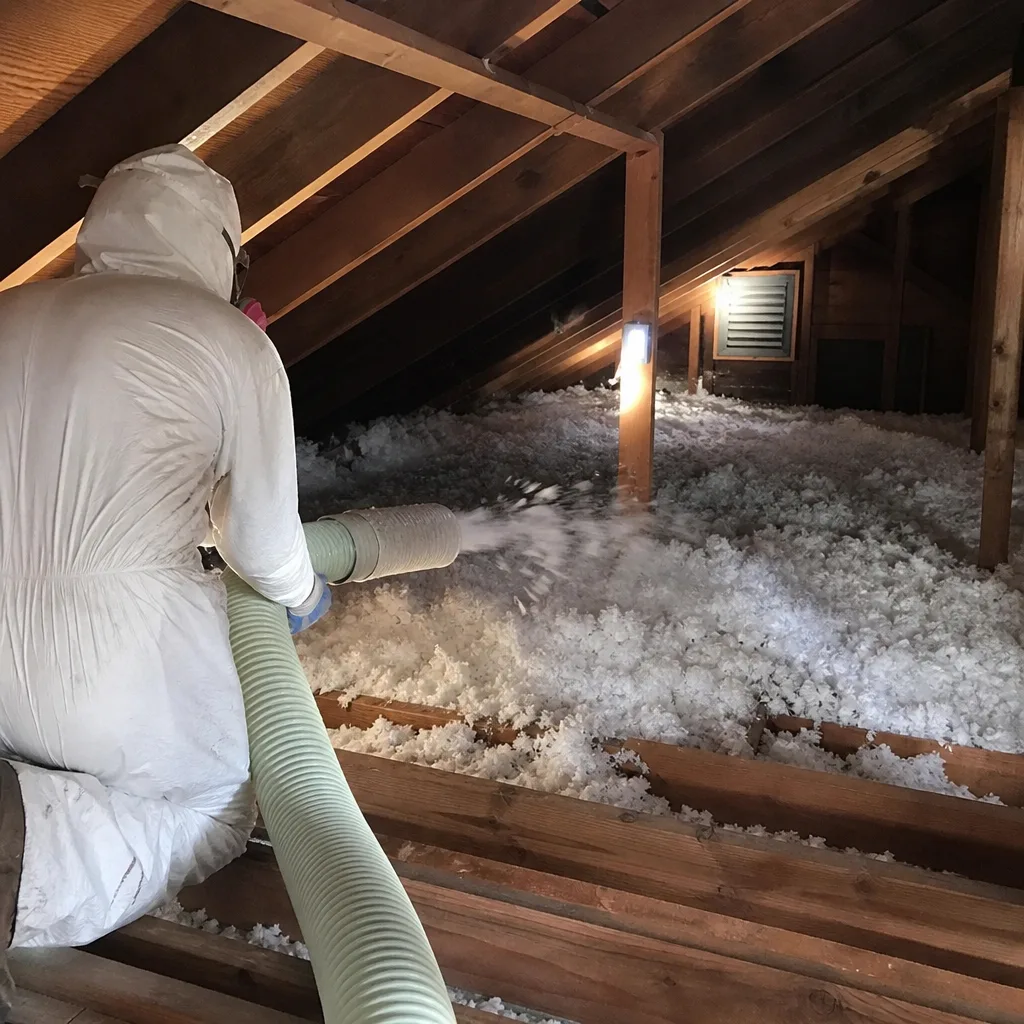
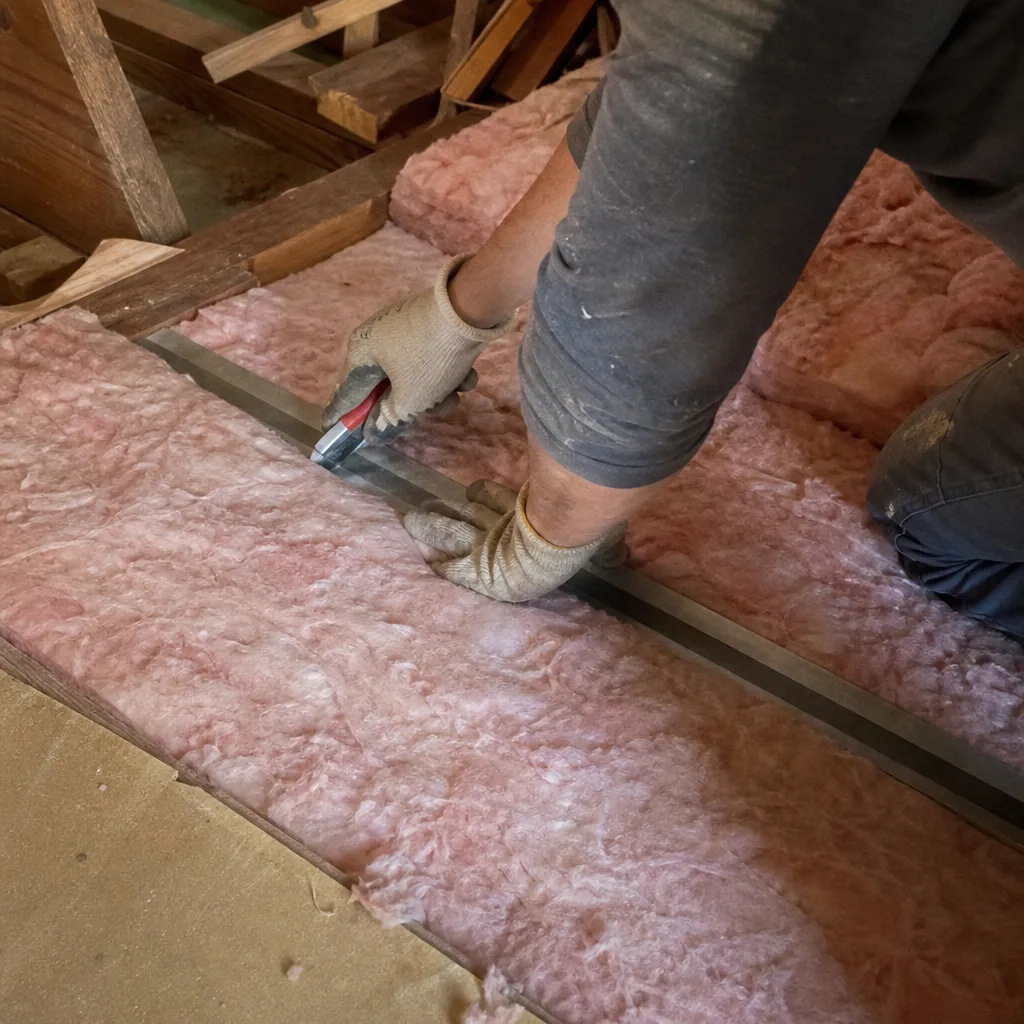
This is the core of the hiring decision. Any contractor can produce a one-page estimate with a bottom-line number. The contractors who will still be accountable six months later produce these seven documents before anyone lifts a tool.
1. Written Scope of Work
Not a proposal. A scope. It specifies: the square footage to be insulated, the target R-value, the material type and brand, the installation method (open blow, dense pack, conditioned attic, etc.), and the air-sealing work that precedes insulation. At Envelope Insulation Co., every scope is delivered under Haven Standard Clause 1: flat price, written scope, written warranty before anyone lifts a tool. We’ve seen Mountain View homeowners receive “scopes” that read “insulate attic to R-38” with no mention of whether existing material will be removed, whether the attic floor will be sealed first, or what happens to can lights and top plates.
2. Material Specification Sheet
The sheet names the manufacturer and product line. Not “Owens Corning fiberglass” - “Owens Corning ProPink L77 loose-fill fiberglass, 0.5 lbs/ft3 minimum settled density.” This matters because product lines within a brand vary significantly in performance and cost. We’ve used materials from Owens Corning, Johns Manville, Knauf, and GreenFiber depending on the application, and each has specifications that affect the job outcome. The spec sheet should also note whether the material meets California’s fire-smoke-toxicity requirements for exposed applications.
3. Installed-Depth Guarantee
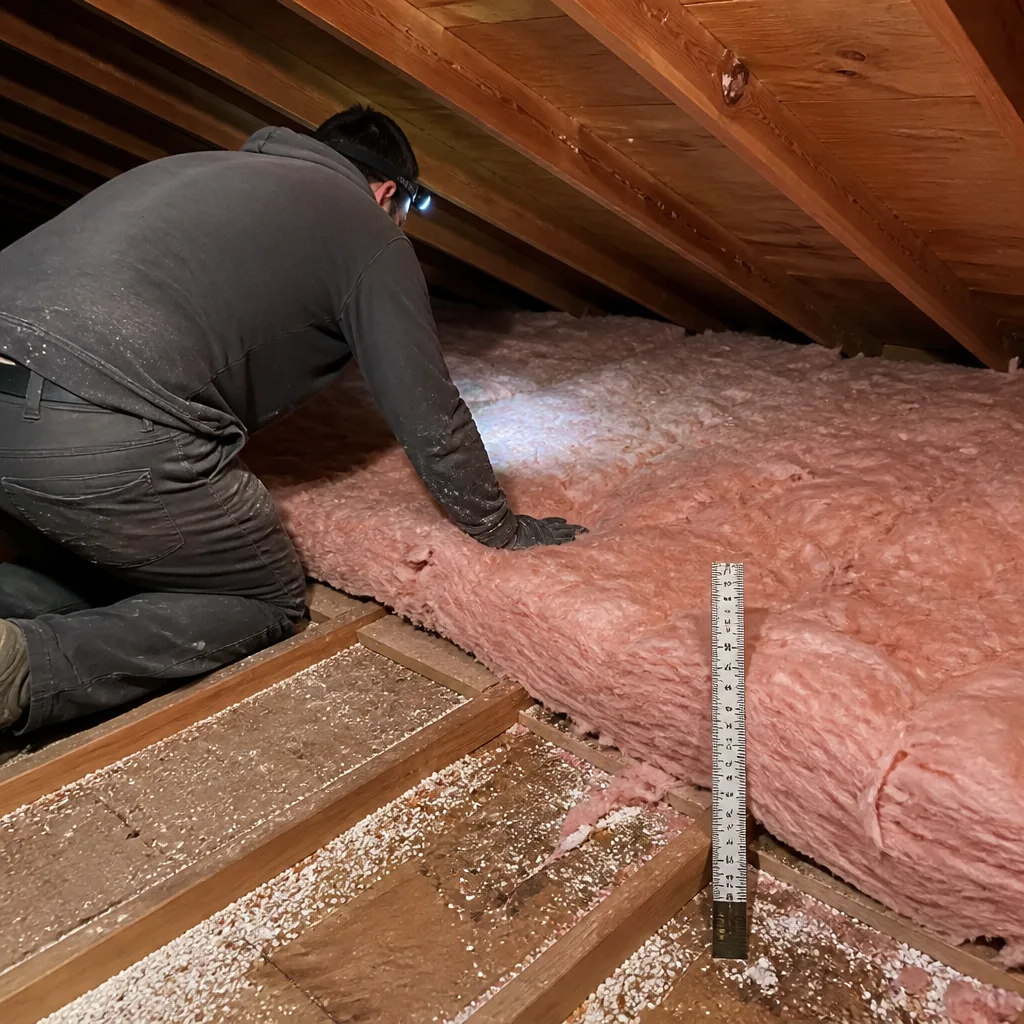
R-value is calculated from installed depth and material density. A contractor guaranteeing “R-38” without specifying the depth required to achieve it, measured where, and verified how, is selling a number, not a result. The guarantee should state: the target depth in inches, the measurement locations (typically every 300 square feet or at structural irregularities), and the correction method if depth is insufficient. In Mountain View’s older neighborhoods like Old Mountain View and the Monta Loma area, irregular joist spacing and mixed framing eras make uniform depth harder to achieve; the guarantee needs to account for this, not ignore it. See our Insulation Cost Breakdown: The Mountain View Homeowner’s Reference for 2026 for typical pricing factors.
4. Blower-Door Baseline (Where Applicable)
For any job involving air sealing, the contractor should provide a pre-work blower-door test - a pressurization reading that shows, in one number, how much air your building envelope is losing, measured in CFM50 (cubic feet per minute at 50 Pascals of pressure). This establishes the performance baseline. Without it, post-work claims of “50% improvement” are unverifiable. At Envelope, we publish before-and-after blower-door numbers on every applicable job. A contractor who won’t perform or share the baseline is asking you to trust, not verify.
5. Permit Disclosure
The disclosure states: whether a permit is required, who will obtain it, the permit number once issued, and how the final inspection will be scheduled. In Mountain View, insulation work in attics and crawl spaces typically requires a building permit under the city’s compliance with Title 24 Part 6. The disclosure should also note whether HERS (Home Energy Rating System) verification is required, which it is for many new insulation installations in California.
6. Cleanup Protocol
Specific, not generic. Where will the hose run? How will the attic access be protected? Who removes old material, and where does it go? Will the crew vacuum the living space at day’s end? In Mountain View’s compact lots and attached housing near downtown, hose routing and debris containment affect neighbors, not just the homeowner.
7. Warranty Terms in Plain Language
Not a manufacturer’s material warranty alone. A workmanship warranty with: duration, what it covers (settling, gaps, moisture damage from improper installation), the claims process, and response time. Our 365-Day Done Right Promise - if it’s not done right, we make it right - is delivered in writing before work starts, not offered verbally after a complaint.
Five Interview Questions That Reveal Whether Air Sealing Is Actually Understood
Most contractors will say they “do air sealing.” Few can explain their process in enough detail to prove they understand it as a prerequisite, not an upsell. These questions separate the two.
Question 1: “Walk me through your air-sealing sequence before insulation goes in.”
Good answer: Specific steps in order - seal top plates and partition walls, box and seal can lights or replace with rated enclosures, seal around chimney and flue penetrations, foam or caulk wire and plumbing penetrations, seal the attic access hatch, then verify with a blower-door test before insulation is loaded.
Evasive answer: “We spray some foam around the obvious stuff” or “air sealing is included.” Included how? To what standard? Verified how? Vagueness here predicts vague execution.
Question 2: “What’s your process if the blower-door test after air sealing doesn’t show at least a 20 percent reduction?”
This is the diagnostic discipline question. Air sealing should produce measurable results. A 20 percent reduction in CFM50 is a conservative minimum for a properly sealed attic floor in a typical Mountain View home built before 1990.
Good answer: “We leak-hunt with a smoke pencil or thermal camera, identify the remaining bypasses, seal them, and retest. We don’t proceed to insulation until the number moves.” This describes a feedback loop, not a one-pass guess.
Evasive answer: “Twenty percent is pretty aggressive” or “the insulation will help with air sealing too.” Fibrous insulation does not air seal. This answer reveals fundamental misunderstanding or deliberate misdirection.
Question 3: “How do you handle can lights in the attic?”
Recessed can lights are among the most common attic bypasses in Mountain View’s housing stock, particularly in 1960s-1980s ranch and split-level homes in neighborhoods like Springer and Rex Manor. Learn what else to watch for in Insulation Warning Signs: A Mountain View Homeowner’s Reference Guide.
Good answer: Distinguishes between IC-rated (insulation contact) and non-IC fixtures, specifies whether covers will be installed or fixtures replaced, and notes the fire-safety requirements for each. May mention Tenmat covers or similar rated enclosures by name.
Evasive answer: “We just blow around them” or “the insulation won’t touch them.” In a blown-in job, insulation will move. Non-IC cans covered with insulation are a fire hazard. This answer is a safety red flag.
Question 4: “What R-value do you recommend for my attic, and how did you determine it?”
Good answer: Cites Title 24 requirements for Mountain View’s climate zone (Zone 4, requiring R-49 for new attic insulation in most cases), then adjusts for existing insulation depth, condition, and the home’s specific thermal characteristics. May note that R-38 is acceptable for retrofits under certain conditions but explains the tradeoff.
Evasive answer: “R-38 is standard” or “most people go with R-49” with no reference to code, existing conditions, or your specific home. This is selling by rote, not designing for performance.
Question 5: “Can I see a completed job file from a similar house?”
Good answer: Produces or offers to produce: the written scope, material spec, before-and-after photos, blower-door readings, and final documentation. At Envelope, our Documented Photo Record on Every Visit is included, not available on request - the homeowner receives it automatically.
Evasive answer: “We don’t share other customers’ information” (redacted examples are standard practice) or “we have great reviews online.” Reviews are not documentation. Documentation is documentation.
How to Read a Line-Item Bid: Three Places Costs Get Hidden
Insulation bids in Mountain View range widely - we’ve reviewed competitor quotes from $2,800 to $7,500 for similar attic footprints. The spread isn’t always explained in the bottom line. Here’s where to look.
1. Mobilization Fees
Some contractors separate “trip charge,” “setup fee,” or “equipment mobilization” as a line item. Others bury it in the per-square-foot rate. The problem isn’t the fee itself; it’s the lack of comparability. Ask: “Is this fee per visit, and how many visits does the job require?” A typical attic insulation job with air sealing requires two visits minimum: air sealing and blower-door verification, then insulation installation. If the bid shows one visit, either air sealing isn’t being verified or the contractor is planning to skip the intermediate test.
2. Disposal of Existing Material
Old insulation removal is often priced separately, and the disposal method matters. Fiberglass batt can be bagged and landfilled. Cellulose with rodent damage requires different handling. Some Mountain View contractors quote removal without specifying disposal costs, then add dump fees as “unforeseen” after work begins. The bid should state: removal cost per square foot, disposal method, and whether hazardous material testing (for asbestos in pre-1980 homes) is included or excluded. Many homes in the Moffett Field and Whisman Station areas date to eras when vermiculite insulation - which may contain asbestos - was common. Testing before disturbance is legally required and should be explicit in the bid.
3. “Air Sealing Included” vs. “Caulk at Visible Penetrations”
This is the most expensive ambiguity in insulation contracting. “Air sealing included” suggests comprehensive work. “Caulk at visible penetrations” describes a cursory pass with a tube of caulk, missing top plates, electrical chases, and the attic-to-wall connections that drive actual leakage. In Mountain View’s climate, where summer heat spikes and winter marine layer coolness create pressure differentials, these missed leaks dominate energy loss.
To compare bids fairly, request that each contractor itemize air-sealing work by component: top plates, can lights, flue penetrations, wire and plumbing penetrations, attic access, duct boots (if applicable). The bid with the higher bottom line but detailed air-sealing scope is often the lower actual cost - because the “cheaper” bid will require corrective work later, or the homeowner will pay the difference in energy bills.
Our Free Second Opinion on Any Written Estimate exists specifically for this comparison. Bring us a competing quote; we will read it with you and identify where scope has been narrowed or costs deferred.
The Post-Job Documentation Package You Should Insist On
The job isn’t complete when the crew leaves. It’s complete when you have the documentation to prove what was done, to verify it performed as promised, and to transfer accountability to a future owner. Here’s what the package should contain.
The Written Completion Statement
A signed document stating: the work performed, the materials installed (with lot numbers where applicable), the installed R-value and depth measurements, the date of completion, and the warranty effective date. This is distinct from the invoice. The invoice asks for money; the completion statement confirms what you bought.
The Blower-Door Result (Air-Sealing Jobs)
Two numbers: pre-work CFM50 and post-work CFM50, with the test date and conditions (indoor-outdoor temperature differential affects results; a competent tester notes this). The percentage reduction should be calculated and stated. In our experience across Mountain View homes, a well-sealed attic floor typically yields 20-40 percent reduction in whole-house leakage, depending on how much leakage originated from the attic plane versus the foundation or walls.
How to use this number: if your post-work CFM50 is 3,200 and your contractor claims “we sealed the attic,” but your pre-work was 3,800, that’s a 16 percent reduction - possible, but modest. Ask what else was sealed and whether the target was appropriate for your home’s starting condition. If the reduction is under 10 percent, the air sealing was likely incomplete or the attic wasn’t the dominant leakage path.
The Photo Record
Before, during, and after photos of: the attic floor before air sealing (showing bypasses), the sealed condition (showing foam, caulk, or covers at penetrations), the insulation installation in progress (showing depth markers), and the completed installation (showing uniform coverage). At Envelope, this Documented Photo Record on Every Visit is delivered automatically; homeowners don’t request it. The photos should be dated and should correspond to the completion statement.
The Permit Final
In Mountain View, the building department issues a final inspection sign-off. Request a copy. If the contractor obtained the permit, they’re responsible for scheduling final inspection. If they didn’t obtain one and one was required, you may face compliance issues at sale or refinance.
The Warranty Document
Our 365-Day Done Right Promise is delivered in writing before work starts and acknowledged in the completion package. It specifies: what constitutes “not done right,” how to initiate a claim, response time, and the remedy (repair, reinstallation, or refund). Verbal warranties are unenforceable. Written warranties with vague language - “we stand behind our work” - are nearly so.
Mountain View-Specific Considerations: Climate, Codes, and Common Issues
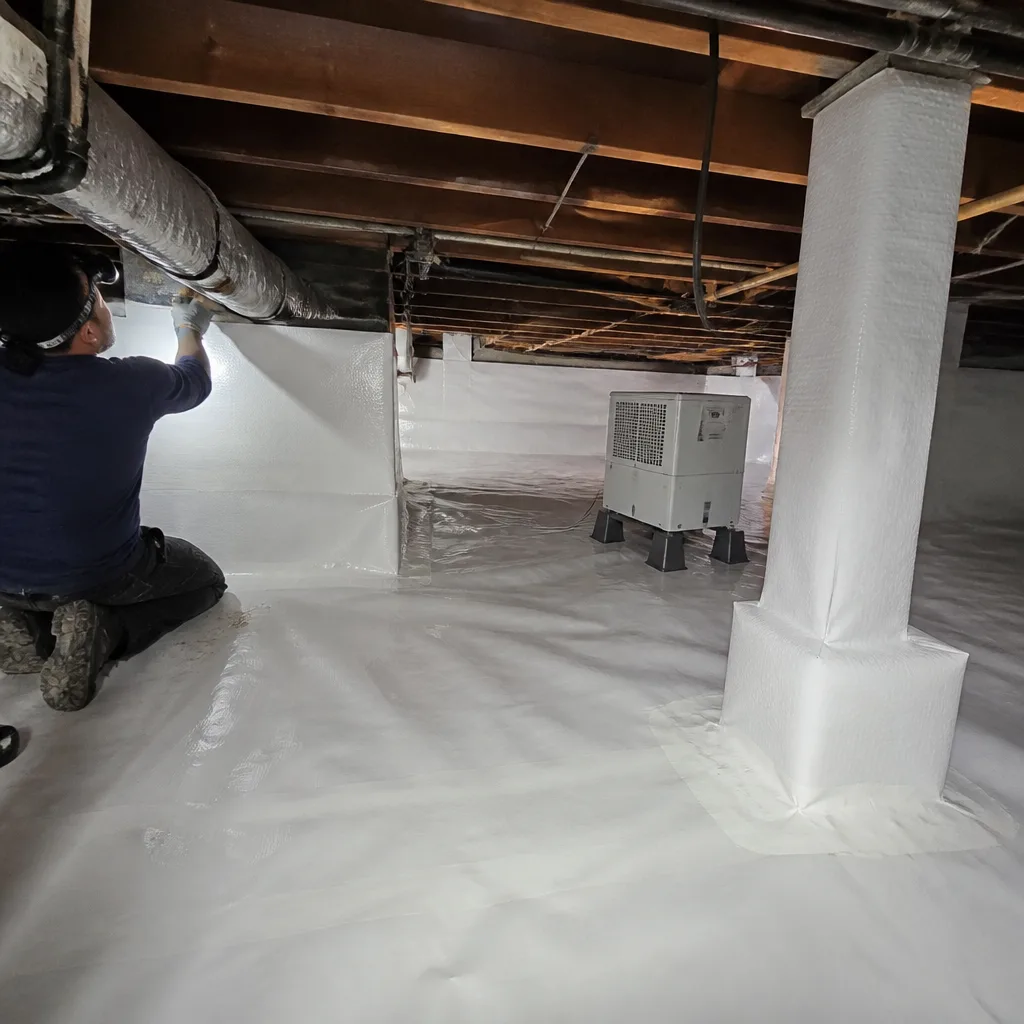
Mountain View sits in California Climate Zone 4, with mild winters, dry summers, and significant diurnal temperature swings. The marine influence moderates extremes but creates specific envelope challenges that generic advice misses.
The Cooling-Dominant Load
Unlike inland California, Mountain View’s energy burden is cooling-dominant or balanced, not heating-dominant. Attic insulation that performs well for winter heat retention may be suboptimal for summer heat rejection. Radiant barrier installation - a reflective surface that reduces radiant heat gain from the roof deck - is often more cost-effective here than in heating-dominated climates. We’ve installed radiant barriers in homes near the Topside Attic Insulation Mountain View home service area where the roof deck temperature exceeds 140°F in July, and the reduction in attic air temperature measurably decreases cooling load.
Title 24 and HERS Verification
California’s Title 24 Part 6 energy code requires HERS verification for many insulation installations - a third-party inspector verifies installed depth, grade, and air-sealing completeness. In Mountain View, HERS raters are familiar with local conditions and common failure modes. A contractor who resists HERS verification or claims it’s “not needed for retrofits” may be misinformed or avoiding accountability. Check with the City of Mountain View Building Division for current requirements; they change with code cycles.
Neighborhood-Specific Construction Eras
Homes in Old Mountain View (pre-1950) often have balloon framing, no top plates, and knob-and-tube wiring remnants - air sealing is technically demanding and requires electrical safety assessment. The Monta Loma and Springer areas (1950s-1970s) typically have pitched roofs with moderate attic space, can-light penetrations, and occasional vermiculite insulation. Whisman Station and newer developments (post-1990) may already have R-30 or better but suffer from duct leakage in conditioned attics. Each era demands different scoping, and a contractor who treats “attic insulation” as a single service regardless of construction era is underserving your home.
Local Material Availability and Sourcing
Mountain View’s proximity to major distribution centers means most specification-grade materials are available without extended lead times. We source from Owens Corning, Johns Manville, Knauf, and GreenFiber depending on the application - no proprietary product lock-in that would limit your options or inflate cost. A contractor pushing a single “exclusive” product line may have a supply agreement, not your best interest, as the motive.
Common Mistakes to Avoid
- Hiring based on price per square foot alone. A low per-square-foot rate with vague air-sealing scope and no depth guarantee will cost more in energy bills and corrective work than a higher initial bid with documented performance. In Mountain View’s competitive market, the spread between lowest and highest responsible bid for a typical attic is often less than $1,500 - recoverable in two to three years of improved efficiency.
- Assuming new insulation over old is always acceptable. Old insulation may be compressed, moisture-damaged, or contaminated. In homes near the Stevens Creek corridor or with history of roof leaks, we often find mold-affected cellulose or fiberglass that should be removed before new material is installed. Covering it traps moisture and obscures the problem.
- Neglecting to verify the permit. Mountain View’s building department maintains online permit history. A contractor who “handles permits” but won’t provide the permit number within 48 hours of application may not have filed. Unpermitted work can complicate insurance claims, refinancing, and sale disclosures.
- Accepting “R-value” without installed-depth verification. R-value is a laboratory measurement at stated density. In your attic, depth and coverage uniformity determine actual performance. Demand depth markers, photographic verification, and the right to inspect before final payment.
- Ignoring the blower-door number. A contractor who performed air sealing but won’t share the before-and-after CFM50 is asking for trust without evidence. In our 9,000+ homes sealed and insulated since 2016, every applicable job includes this number because it’s the single most concise proof of performance change.
- Failing to ask about cleanup and protection. Mountain View’s dense neighborhoods mean your crew’s hose routing, debris containment, and vehicle parking affect your relationship with neighbors. A contractor who hasn’t thought about this hasn’t thought about the full job.
- Not getting the warranty in writing before work starts. Verbal promises of “we’ll take care of you” evaporate when the crew foreman moves to another company. Our Haven Standard requires written warranty delivery with the scope - before anyone lifts a tool.
When to Call a Professional
Call a professional insulation contractor when: your energy bills are rising without rate increases, rooms have persistent temperature stratification, the attic insulation appears uneven or damaged, you’re finishing a remodel that disturbed the thermal envelope, or you’re preparing to sell and want clean documentation for disclosure. In Mountain View’s market, documented energy improvements can accelerate sale timelines and reduce buyer negotiation leverage.
For homes with pre-1980 construction, call before disturbing any existing insulation - asbestos testing is legally required and personally protective. For homes with rodent activity in the attic, the sequence matters: exclusion and sanitization before insulation, or you’ll be reinsulating within years.
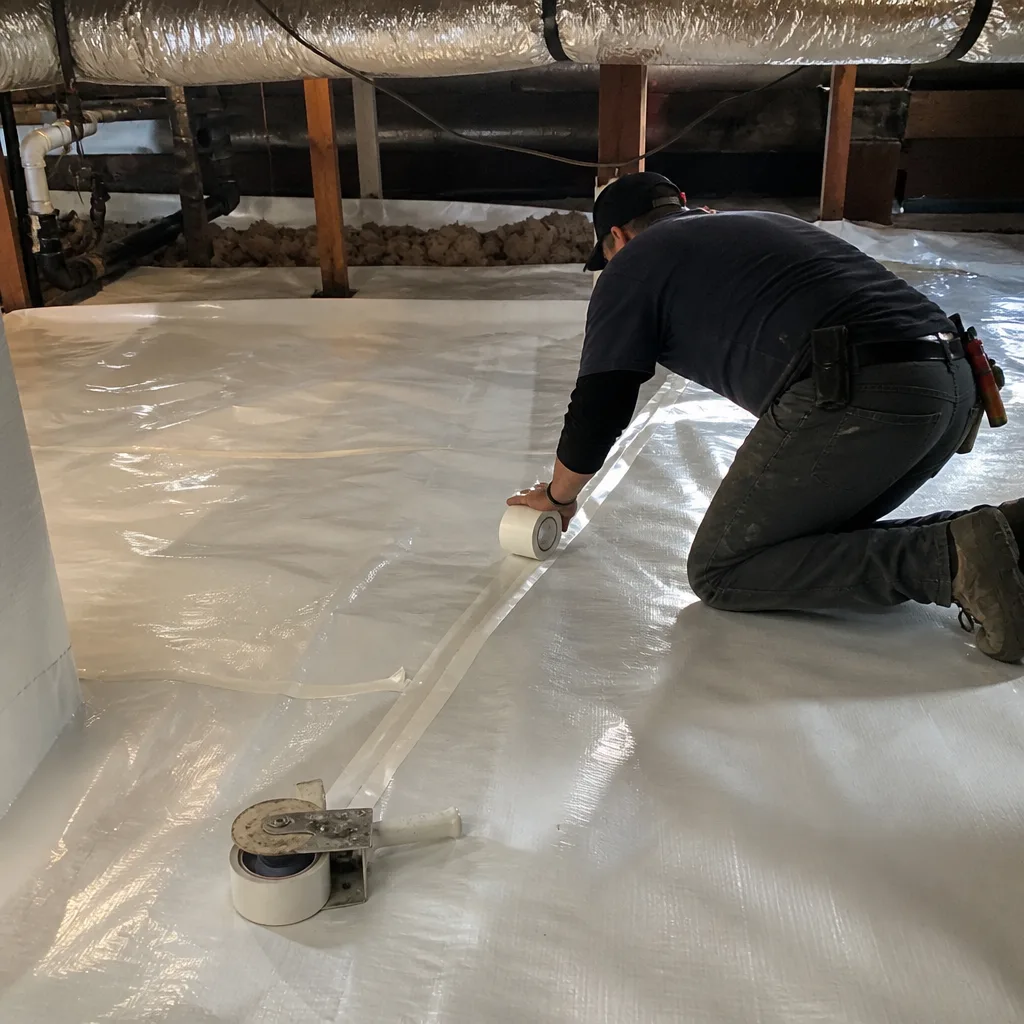
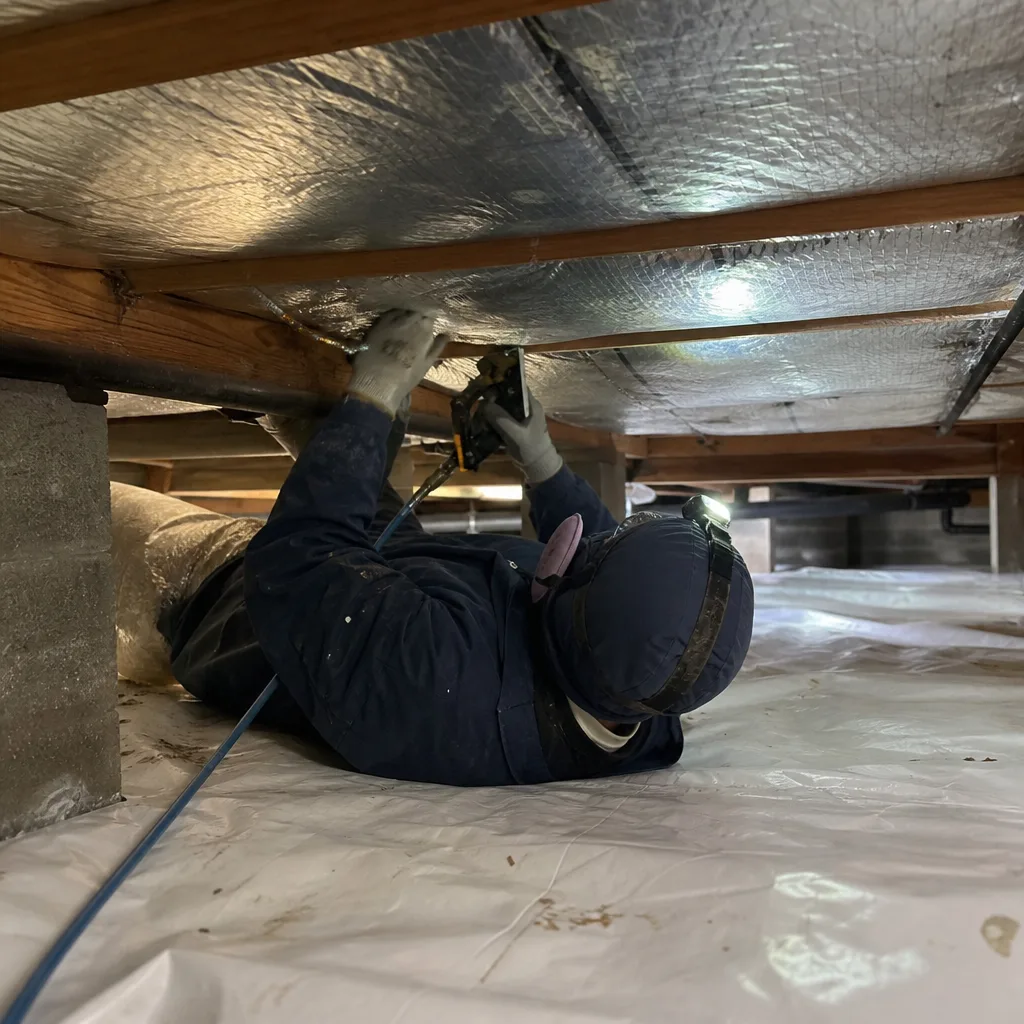
Attic Insulation in Mountain View from Topside Attic Insulation Mountain View includes a free estimate with written scope, upfront pricing, and no obligation. We also provide Crawl Space Encapsulation & Vapor Barrier in Mountain View and Spray Foam Insulation in Mountain View for complete envelope solutions. Call (669) 259-0406 to schedule - estimates are free, and you’ll receive a Written Price Before Any Work Starts.
Frequently Asked Questions
Most attic insulation jobs in Mountain View homes between 1,200 and 2,400 square feet run between $3,200 and $6,800, depending on existing material condition, accessibility, and whether air sealing and old insulation removal are included. Jobs requiring only blown-in fiberglass over intact existing insulation fall at the lower end; jobs with full removal, air sealing, and premium dense-pack cellulose or spray foam fall higher. Call (669) 259-0406 for an exact quote - estimates are free, and we provide a Written Price Before Any Work Starts.
Yes, most attic insulation work in Mountain View requires a building permit under Title 24 compliance. The permit ensures HERS verification where required and creates a record for future owners. A legitimate contractor will obtain the permit, schedule inspections, and provide the final sign-off documentation. If a contractor suggests skipping the permit, that’s a significant red flag.
A typical attic insulation job with air sealing takes one to two days: one day for air sealing and blower-door verification, a second day for insulation installation and final documentation. Complex jobs with old insulation removal, rodent damage repair, or spray foam curing may extend to three days. We provide a specific schedule in the written scope before work begins.
Fiberglass, typically from Owens Corning or Johns Manville, is inorganic, doesn’t absorb moisture, and maintains R-value if briefly wet. Cellulose, including products from GreenFiber, is treated paper fiber with borate fire retardant, denser and more resistant to air movement when properly installed, but more sensitive to moisture. In Mountain View’s climate, both perform well when installed to specification; the choice depends on application, budget, and specific performance goals. We specify the material in writing before installation - no surprises.
Sometimes, but not always. If existing insulation is dry, uncompressed, uncontaminated, and the attic floor has been properly air sealed, adding new material over old can be cost-effective. If old insulation shows moisture damage, rodent activity, compression below labeled thickness, or vermiculite content, removal is necessary. We assess this during our free estimate and specify the approach in the written scope.
A blower-door test is a pressurization reading that shows, in one number, how much air your building envelope is losing. A powerful fan depressurizes the house while sensors measure airflow required to maintain that pressure. The result, in CFM50, quantifies total leakage. Before-and-after tests prove that air sealing actually changed the house’s performance - not just that caulk was applied. At Envelope, we provide this number on every applicable job so homeowners can verify their results.
The Bottom Line
Hiring an insulation contractor in Mountain View isn’t about finding the lowest bid or the longest list of reviews. It’s about finding a contractor who will document what they promise, prove what they delivered, and remain accountable after the crew leaves. The seven disclosures - written scope, material spec, depth guarantee, blower-door baseline, permit disclosure, cleanup protocol, and warranty terms - are your protection against the most common complaint the state receives: paying for performance you can’t verify. Ask the five interview questions. Read the bid for hidden costs. Demand the post-job documentation package. And remember: in a trade where the finished product is literally hidden from view, documentation isn’t paperwork. It’s the product.
Written by Wes Okafor, Owner at Topside Attic Insulation Mountain View, serving Mountain View since 2016.