
Crawl Space Vapor Barrier in Mountain View, CA
A crawl space vapor barrier is a thick polyethylene sheet – typically 12 to 20 mil – installed across the ground and up the foundation walls of your crawl space to block soil moisture before it migrates into your floor system and living areas. In Mountain View, where marine air off the Bay pushes relative humidity well above 70% on many mornings, an unprotected crawl space dirt floor can release enough moisture vapor to rot floor joists, grow mold on subfloor sheathing, and drive up heating costs – often before a homeowner notices anything from inside the house. Most Crawl Space Encapsulation & Vapor Barrier services we complete in Mountain View run between $1,200 and $3,800, depending on crawl space square footage, access difficulty, and whether old deteriorated poly needs to be removed first.
This page covers the sub-service of vapor barrier installation specifically. If you want to understand how a vapor barrier fits into a complete moisture control system – including drainage matting, rim joist sealing, and mechanical ventilation – the full picture is on our Crawl Space Encapsulation & Vapor Barrier in Mountain View page. For a written price on your home before any work begins, call us at (669) 259-0406 – a live person picks up, any hour.
Envelope Insulation Co. has been independently owned and operated since 2016, and Wes Okafor leads every project under The Haven Standard: a written price before any work starts, a documented photo record when the crew leaves, and a 365-Day Done Right Promise covering the completed installation. No exceptions on any of those three.
When You Need a Crawl Space Vapor Barrier
- Musty smell rising through floor registers or near baseboards. In Mountain View’s older neighborhoods – Castro City, Monta Loma, the streets east of Castro Street built in the 1950s and 1960s – we consistently find bare dirt crawl spaces where that smell traces directly to active moisture evaporation and early-stage mold growth on the subfloor above.
- Wood moisture readings above 19% on floor joists or subfloor sheathing. Our technicians measure wood moisture on every crawl space visit. Readings above 19% put wood in the range where decay fungi can become established, and readings above 28% mean active rot is possible. Neither condition corrects itself without addressing the moisture source at the ground.
- Condensation on HVAC ducts, pipes, or the underside of the subfloor. When soil moisture evaporates freely, it contacts cooler surfaces and condenses. In Mountain View homes with HVAC ducts routed through the crawl space – common in slab-adjacent split-level builds near Cuesta Park – duct sweating signals a vapor problem that insulating ducts alone will not fix.
- Existing poly sheeting that is torn, thin (under 6 mil), or installed only under a portion of the crawl space. Partial coverage is close to no coverage. Moisture finds every uncovered patch. If your home has a vapor barrier that was stapled to the joists rather than weighted or sealed at the perimeter, it almost certainly has gaps at the foundation walls – which is exactly where most of the evaporation occurs.
- Elevated indoor humidity that HVAC dehumidification cannot keep pace with. Mountain View’s coastal microclimate means outdoor dew points regularly sit in the 55-65°F range from April through October. If your central air runs longer cycles than neighbors with similar homes, the crawl space is a credible source and worth a moisture inspection before blaming the equipment.
- Pest remediation that exposed bare soil. Rodent proofing and cleanout work – which our home page lists as a standalone service – often requires removing old, damaged poly. Once the old material comes out, replacing it with a properly lapped and sealed barrier is not optional; bare soil is a faster moisture path than the deteriorated poly it replaced.
Our Crawl Space Vapor Barrier Process
-
Pre-Installation Moisture Assessment
Before we touch a roll of poly, we measure. That means a calibrated moisture meter reading on multiple joist and subfloor locations, a visual check for active mold or rot, and a physical inspection of existing vapor barrier material if any is present. We also document the crawl space access point, clearance height, and any standing water or drainage issues that would affect installation quality. All of this is photographed under our Documented Photo Record – so you have a baseline record of conditions before we changed anything.
-
Debris and Old Material Removal
Torn or degraded poly does not get buried under new material. We pull it out, bag it, and haul it away. Same for any organic debris – leaves, rodent nesting material, deteriorated fiberglass batts that have fallen from the floor above – that would trap moisture under the new barrier. Installing over existing debris is a shortcut that undermines the installation before it is even finished.
-
Ground Surface Preparation
We grade and level loose soil where needed to eliminate pooling pockets, move any rocks or debris that would puncture the liner, and check that the perimeter drainage grade directs water away from the foundation rather than toward it. In Mountain View crawl spaces where irrigation overspray from adjacent landscaping is a factor – something we see frequently in Waverly Park and Rex Manor neighborhoods – we flag any exterior grading issues in writing so the homeowner can address them separately.
-
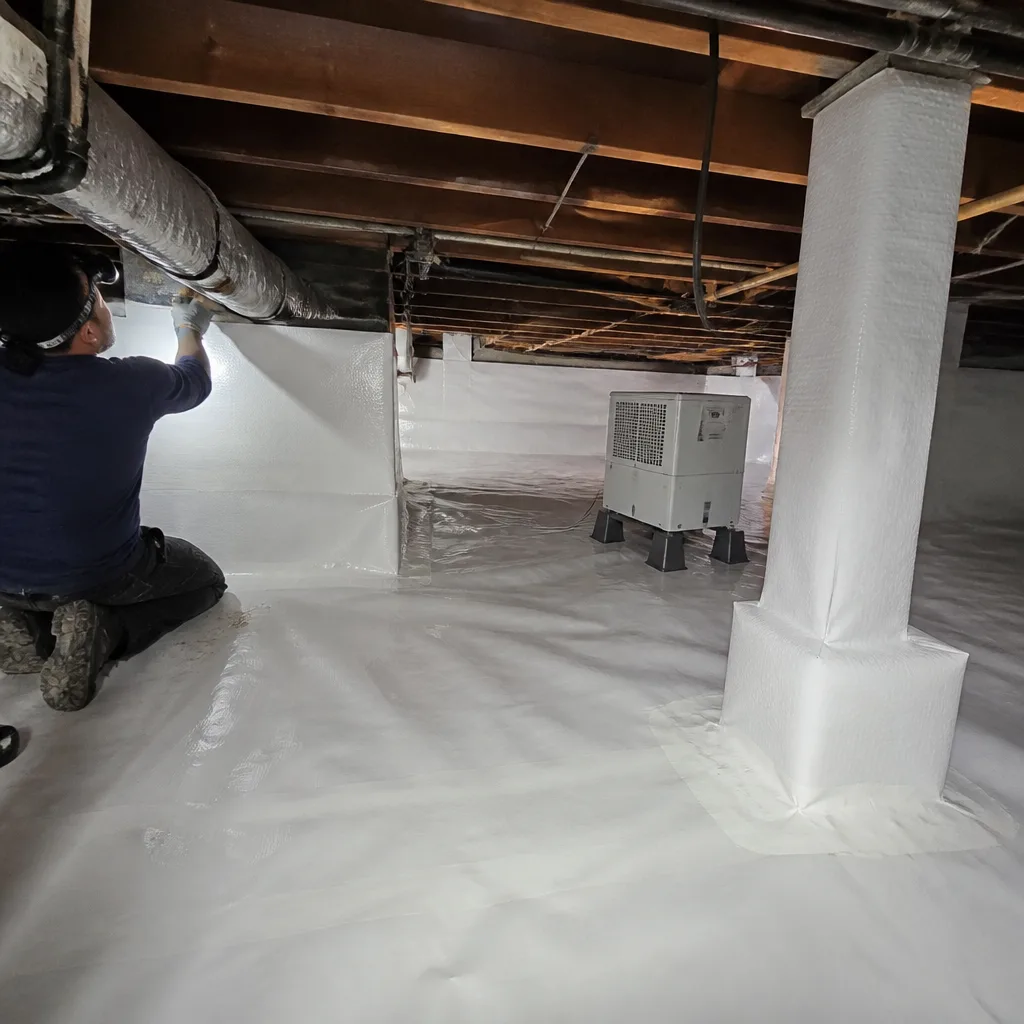
Barrier Installation and Lapping
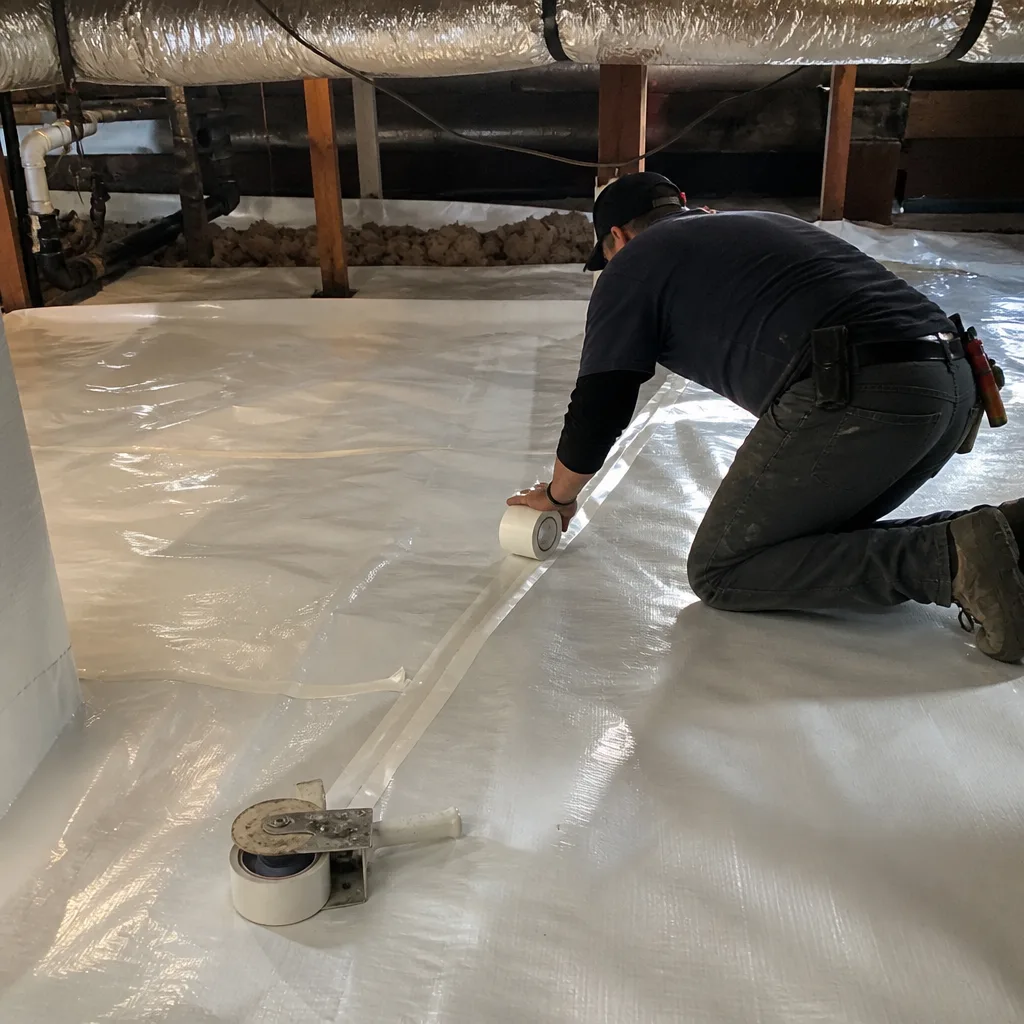
We install a minimum 12-mil reinforced polyethylene liner across the full crawl space floor, running it up each foundation wall to at least 6 inches above grade (and typically higher where code or conditions call for it). Seams between sheets overlap a minimum of 12 inches and are sealed with purpose-made vapor barrier tape, not staples. The wall termination is secured with mechanical fasteners and sealed at the top edge so the barrier does not peel away from the foundation over time. We source liner material from Johns Manville and other proven building-science suppliers – no off-brand poly that degrades in 5 years.
-
Penetration Sealing
Every pipe, post base, and column that passes through the liner gets its own sealed collar. These penetrations are where vapor barriers fail most often: a slit around a post accumulates into a meaningful open area across a crawl space with eight or ten supports. We treat each one individually, tape and seal the collar, and photograph it. The photo record means you can see that this step was completed, not take our word for it.
-
Post-Installation Documentation and Walkthrough
When the crew is finished, Wes Okafor or the lead technician walks you through the completed installation – either in person or via a video call with the photo record pulled up – and explains what was installed, where seams are located, and what conditions to watch for going forward. You receive the written scope, the warranty documentation, and the photo record before we leave. Under the Haven Standard, that closing documentation is not optional and is not available “by request” – it is part of what the job costs.
Crawl Space Vapor Barrier Pricing in Mountain View
How Much Does Crawl Space Encapsulation & Vapor Barrier Cost? (2026 Price Guide) - Mountain View, CA: vapor barrier installation here typically runs between $1,200 and $3,800 for a single-family home crawl space. The range is wide because crawl space conditions vary significantly – a clean, accessible 800-square-foot crawl space with 36 inches of clearance is a different job than a 1,600-square-foot crawl space with 18 inches of clearance, existing debris, and deteriorated poly to remove. The table below gives realistic per-project ranges based on what we actually see in Mountain View homes.
| Scenario | Typical Range |
|---|---|
| Small crawl space (under 800 sq ft), clean, good access | $1,200 – $1,800 |
| Mid-size crawl space (800 – 1,400 sq ft), standard conditions | $1,800 – $2,600 |
| Large crawl space (1,400 – 2,200 sq ft) or difficult access | $2,600 – $3,800 |
| Old poly removal and disposal (added to installation cost) | $200 – $600 |
| Penetration sealing – complex (many posts, pipes, columns) | $150 – $400 added |
What pushes cost up: low crawl space clearance (under 24 inches slows everything), large square footage, significant debris or damaged poly to remove, and a high number of penetrations. What keeps cost closer to the floor: good access, minimal existing material to remove, and a straightforward rectangular footprint.
Under Haven Standard Clause 1, you receive a written, flat price before any work begins. No hourly-rate surprises, no scope changes added after the crew arrives. If you have a competing written estimate, bring it – we offer a free second opinion on any written quote and will read it with you line by line.
To get a written price for your Mountain View home, call (669) 259-0406. Estimates are free and come in writing.
FAQs – Crawl Space Vapor Barrier
What thickness vapor barrier does a Mountain View crawl space actually need?
For Mountain View conditions, we install a minimum 12-mil reinforced liner as part of our Crawl Space Insulation work – and in crawl spaces with low clearance or higher foot traffic risk during future maintenance, we recommend 20 mil. The building code minimum in California is 6 mil, but 6-mil poly degrades noticeably within a few years, tears easily around penetrations, and does not hold a sealed seam as reliably as heavier material. The small cost difference between 6-mil and 12-mil over a 1,200-square-foot crawl space is typically $150 to $300 – not worth skimping on when the goal is a 20-year installation. Call (669) 259-0406 and we can tell you what we’d recommend for your specific crawl space geometry before you commit to anything.
Is a vapor barrier the same as crawl space encapsulation?
A vapor barrier is one component of full encapsulation – not the same thing. A vapor barrier installs poly on the ground and up the walls to block soil moisture. Full Crawl Space Encapsulation & Vapor Barrier in Mountain View typically adds rim joist sealing, drainage matting under the liner, and sometimes a dedicated dehumidifier or mechanical ventilation to control humidity in the sealed space. For many Mountain View homes, a well-installed vapor barrier alone addresses the primary moisture problem; for others – particularly those with persistent condensation or a history of standing water – the full encapsulation system is the right scope. The site assessment tells us which applies to your home before we price anything.
How long does a crawl space vapor barrier installation take?
Most single-family crawl space vapor barrier installations in Mountain View are completed in one day – typically 4 to 8 hours depending on crawl space size and access conditions. A job with significant debris removal or many penetrations to seal may run into a second half-day. We give you a specific time estimate in the written scope before work starts, so you know what the crew’s schedule looks like, not a vague “a few hours.” Call (669) 259-0406 to schedule and get that time estimate in writing.
Will a vapor barrier fix the musty smell in my Mountain View home?
A vapor barrier fixes the moisture source that causes the smell – but if mold has already established itself on floor joists or subfloor sheathing, the barrier alone does not remediate existing mold growth. In our pre-installation assessment, we note and document any visible mold. If active mold is present, we’ll tell you clearly and refer you to a licensed mold remediation contractor before proceeding with the barrier installation – because installing poly over active mold growth traps the problem rather than solving it. Most musty smells in Mountain View crawl spaces do trace back to uncovered or poorly installed vapor barriers, and after proper installation and any necessary mold remediation, the smell typically dissipates within a few weeks as the wood moisture level drops. For a specific assessment of your situation, call (669) 259-0406.
Why Mountain View Homeowners Work With Envelope Insulation Co.
The Bay Area has no shortage of contractors willing to staple 6-mil poly to the joists, charge a flat fee, and move on. What that approach produces is a vapor barrier that looks complete on the day it is installed and fails within 3 to 5 years – sagging, torn at penetrations, pulled away from the foundation walls, and ultimately less effective than if nothing had been installed at all, because condensation now collects on the underside of the poly rather than evaporating back out.
Envelope Insulation Co. has completed work in over 9,000 homes since 2016, every one of them with a written price before work started and a documented photo record when the crew left. Wes Okafor built the company on the position that documentation is not a marketing feature – it is how you verify that the scope you paid for was actually completed. That includes this service: when the vapor barrier installation is done, you have photos of the ground coverage, the seam laps, the wall terminations, and the penetration collars. You can show those photos to any building inspector or future buyer without qualification.
The 365-Day Done Right Promise means that if any element of the installation is not right – a seam separating, a penetration collar failing, wall poly peeling from the foundation – we come back and correct it within the warranty period, at no additional cost. That commitment is written into your scope document before the crew starts, not offered verbally after the fact.
For Mountain View homes specifically, our technicians are familiar with the crawl space configurations common to the neighborhoods we serve most often: the low-clearance crawl spaces in post-war builds around Rengstorff Park, the partial crawl spaces in split-level homes near Cuesta Drive, and the deeper foundation crawl spaces in older Monta Loma properties. Familiarity with local construction patterns means faster assessments and fewer surprises on installation day.
Key Takeaways
- Crawl space vapor barrier installation in Mountain View typically costs $1,200 to $3,800 for a single-family home, depending on crawl space size, access, and existing conditions.
- A minimum 12-mil reinforced liner – not the 6-mil code minimum – is what we install, with sealed seams and mechanical wall terminations that hold for decades rather than years.
- Every installation includes a Documented Photo Record and closes with a written warranty under the 365-Day Done Right Promise.
- The written price comes before any work starts – Haven Standard Clause 1, no exceptions.
- If existing mold is found during the pre-installation assessment, we document it and tell you before proceeding – not after the barrier is down.
- Mountain View’s coastal humidity levels make a properly installed vapor barrier one of the higher-value moisture control investments available for homes with an accessible crawl space.
Get a Written Price for Your Mountain View Crawl Space
If you’re seeing the signs – elevated humidity, musty odors, deteriorated poly, or condensation under the floor – the next step is a site assessment and a written price. Call Envelope Insulation Co. at (669) 259-0406 to schedule. A live person picks up any hour of the day. Estimates are free, they come in writing, and no work begins until you have reviewed and approved the written scope. If you already have a competing estimate in hand, bring it along and we’ll give you a free second opinion on it.
Written by Wes Okafor, Owner at Topside Attic Insulation Mountain View, serving Mountain View since 2016.